Search Box

Saturday, 26 March 2022

TDS on Cash withdrawals exceeding ₹1 cr: Rajasthan HC issues Notice on PIL challenging constitutionality of S.194N of the IT Act

The Rajasthan High Court, Jaipur has recently issued notice in a public interest litigation challenging the constitutionality of Section 194N of the Income Tax Act, 1961.

The provision was inserted by the Finance Act, 2019 and became effective from September 1, 2019. The provision mandates the deduction of tax at source at the rate of 2% on cash withdrawals from, inter alia, a banking company exceeding Rs. 1 crore in a financial year.

The Bench of Acting Chief Justice Manindra Mohan Shrivastava and Justice Sameer Jain, observed,

"Issue notice to the respondents, returnable within four weeks. PF be filed within one week."

The plea stated,

"The validity of Section 194N providing for 2% TDS on cash withdrawals exceeding Rs. 1 crore or Rs. 20 Lakh as per their respective conditions is doubtful. Since tax to be deducted at source is on cash withdrawals which shall not be treated as income, the question of deduction of any tax at source does not arise. When the transaction is not liable to levy of income tax, the question of deduction of income tax at source with a provision for adjustment of the same against the ultimate tax liability cannot be said to be legal."

It was also added in the plea,

"Section 194N provides for deduction of income tax at source on cash withdrawal exceeding Rs.1 Crore, and the said cash withdrawal is not income liable to be taxed under the Income Tax Act, the aforesaid provision of deduction of tax at source with a provision for adjustment of the same against the ultimate tax liability of the said person, in view of the decisions of the Apex Court as well as basic objective of the Income Tax Act, is clearly ultra vires and unconstitutional."

It was also stated in the plea that in common parlance applying the Literal Rule of Interpretation on the objective of the Income Tax Act, it is very simply derived that this Act is applicable over the Income of the individual. So, charging the same on the Cash Withdrawal from Bank Account is completely against the Act and illegal in nature, added the plea.

Moreover, it was mentioned in the plea that as per the provision, tax can be deducted or collected at source only on the income of the assessee. The plea also stated that cash withdrawal from one or more accounts maintained with a bank, cooperative society engaged in the business of banking or a post office, does not involve the character of income of the recipient and hence cannot be said to be a payment. They are merely returning the money, which belongs to the recipient, on demand of the recipient, added the plea.

Hence, the petitioner alleged that cash withdrawal from banks cannot under any stretch of imagination be treated as the income generated by the recipient as one cannot make income from himself.

The plea stated,

"Section 198 of the Act states that the tax deducted at source is income received. The above section was also amended by the Notice of Amendments to Finance Bill, 2019 as introduced in the Lok Sabha on 18 July 2019 by adding a proviso to Section 198. The added provision itself intends to mean that the tax deducted on withdrawal of cash shall not be the income of an assessee and hence clearly shows that the TDS on withdrawal of cash is not on income and therefore is in violation of Section 190 of the Act."

The petitioner relied on the case of Apeejay Tea Ltd. Anr. v. Union of India, wherein Calcutta High Court granted an interim order restraining the concerned respondents authorities from deducting tax on source on the basis of the aforesaid provisions of Section 194N.Further reliance on Kanan Devan Hills Plantations Company Pvt. Ltd v. Union of India wherein a writ petition had been admitted by Kerala High Court on the same issue and accordingly an interim stay on deduction of tax on source under Section 194N of the Income Tax Act was imposed.

In addition to this, reliance was also placed on Bhawani Cotton Mills Ltd. vs State of Punjab, where while dealing with the levy of purchase tax, Supreme Court held that if a person is not liable for payment of tax at all at any time, the collection of a tax from him with a possible contingency of refund at a later stage will not make the original levy valid.

Additionally, petitioner also relied on Union of India vs. M/S Tata Chemicals Ltd., where Supreme Court observed that since there being no express statutory provision for payment of interest on the refund of excess amount/tax collected by the Revenue, the government cannot shrug off its apparent obligation to reimburse the deductors lawful monies with the accrued interest for the period of undue retention of such monies. The State having received the money without right, and having retained and used it, is bound to make the party good, just as an individual would be under similar circumstances, added the Apex court.

Further, the plea added,

"Article 265 of the Constitution of India states that "no tax shall be levied or collected except by authority of law." Further, Seventh Schedule of the Constitution of India defines and specifies the allocation of powers and functions between the Union and the States. None of the lists (Union List or Concurrent List) of the Seventh Schedule empowers the levy of tax on expenditure. Hence, the expenditure tax is unconstitutional.

The plea alleged that Section 194N will lead to deduction of huge amounts of TDS and it will result in loss in Working Capital of the Business.

Case Title: Abhay Singla v. Union of India

Source from: https://www.livelaw.in/news-updates/rajasthan-high-court-pil-challenging-constitutionality-section-194n-income-tax-act-194968


Summary of Parameters for Scrutiny of GST Return

Summary of Parameters for Scrutiny of GST returns (FY 17-18 & 18-19) as per SOP issued via Instruction No 02/2022-GST!! 

*What is Adjudication u/s 73 or 74?*

What is Adjudication u/s 73 or 74?

'Scrutiny of Returns' or 'Audit by department' doesn't conclude directly into the Order.

S.74 can be invoked due to reasons of 'fraud, wilful-mis statement or suppression of facts' 
S.73 for others than above reasons. 
What is Adjudication u/s 73 or 74?

Major difference between these 2 section is,
A. Penalty
B. Time barred limit to issue SCN and order

Below is the Summary Table for Penalties under these 2 sections: 
B. Time barred limitations under these 2 sections are as below: 
The whole process flow of adjudication u/s 73/74 is as below

Remember, there is no automatic Personal Hearing for this process, the same need to be asked in reply to SCN! 


Friday, 25 March 2022

GST ASSESSMENT V/S GST AUDIT🤔

THREAD
BASIC THINGS ONE MUST KNOW before attending any notice for GST Assessment or Audit.

Image shows various types of "Assessment"/ "Audit by department"

Out of which, S61 and S65 are most invoked sections.

S.61 Scrutiny of Returns

- is it Detailed Manual Scrutiny (DMS) as was there in Service Tax era?: NO

- Can Proper Officer ask for additional documents?: NO, they just need to scrutinize the returns available on their records.

Sec. 61 cont..

- If Proper officer doesn't satisfied with reply in ASMT-11, will he directly issue Demand order?: NO, detailed SCN to be given u/s 73/74, detailed reply by TaxPayer should be given. (what is 73/74?, In a bit).

Detailed Simplified Table for S.61 as below

S.65 Audit by Tax Authorities

- will it be done at Taxpayer's premise?: Yes, or officer may do it 'Desk Audit' at their premise
- is it inspection/search?: NO, the officer might visit the premise, but well intimating before 15 days
- RP need to furnish Books and information ⬇️ 
S.65 cont

- Can they insist upon spot recovery? - NO
- If they don't agree with the reply to their discrepancies, will it amount to Demand Order? - NO, detailed SCN to be given u/s 73/74 for which detailed reply to be filled.

Detailed Simplified Table for S.65 is as below


Monday, 14 March 2022

GST Council to consider input tax credit to hotels, restaurants; may increase GST to 12-18%

 The Government could give input tax credit to hotel and restaurant industry which is currently not given at the current 5 percent Goods and Services (GST) tax levy, Zee Business' Tarun Sharma reports. The decision could be taken in the next GST Council meeting in April.

The GST Council is expected to take a major decision on the issue of GST on hotels and restaurants, Sharma said adding that the levy could go up from 5 percent now to 12 percent or 18 percent. It could also allow input tax credit to the industry, which till now was not available. 

The demand for input tax credit was longstanding from the industry and this could now be considered during the GST council meeting, Sharma added.   

A report on GST rate rationalisation is being prepared under the Chairmanship of Karnataka Chief Minister Basavaraj Bommai which is expected to be submitted in the first week of April, just ahead of the meeting of the rate rationalisation committee, Sharma said in his report. 

All those hotels whose tariff is Rs 7500 or more are subjected to an 18 percent GST and can avail input tax credit.  

Source from: https://www.zeebiz.com/india/news-exclusive-gst-to-consider-input-tax-credit-to-hotels-restaurants-may-increase-gst-to-12-18-180876


Friday, 4 March 2022

Latest Updates on ITC under GST

 1 फरवरी 2022

बजट 2022 अपडेट-

1. आईटीसी का दावा नहीं किया जा सकता है यदि यह धारा 38 के तहत उपलब्ध जीएसटीआर -2 बी में प्रतिबंधित है।

2. किसी वित्तीय वर्ष के इनवॉइस या डेबिट नोटों पर आईटीसी का दावा करने की समय सीमा को पहले की दो तारीखों में संशोधित किया गया है। पहला, अगले साल का 30 नवंबर या दूसरा सालाना रिटर्न दाखिल करने की तारीख।

3. धारा 38 को फॉर्म GSTR-2B के अनुरूप 'आवक आपूर्ति और इनपुट टैक्स क्रेडिट के विवरण का संचार' के रूप में पूरी तरह से नया रूप दिया गया है। यह आईटीसी दावों के तरीके, समय, शर्तों और प्रतिबंधों को निर्धारित करता है और फॉर्म जीएसटीआर -2 में निलंबित रिटर्न पर जीएसटी रिटर्न फाइलिंग में दो-तरफा संचार प्रक्रिया को हटा दिया है। इसमें यह भी कहा गया है कि करदाताओं को दावों के लिए योग्य और अपात्र आईटीसी की जानकारी प्रदान की जाएगी।

4. अनंतिम आईटीसी दावों के संदर्भों को हटाने के लिए धारा 41 को भी संशोधित किया गया है और शर्तों के साथ स्व-मूल्यांकन आईटीसी दावों को निर्धारित किया गया है।

5. अनंतिम आईटीसी दावा प्रक्रिया, मिलान और प्रत्यावर्तन पर धारा 42, 43 और 43ए को समाप्त कर दिया गया है।


29 दिसंबर 2021

GSTR-2B में प्रदर्शित होने वाले ITC के अलावा 5% अतिरिक्त ITC को हटाने के लिए CGST नियम 36 (4) में संशोधन किया गया है। 1 जनवरी 2022 से, व्यवसाय आईटीसी का लाभ तभी उठा सकते हैं जब यह आपूर्तिकर्ता द्वारा GSTR-1 / IFF में रिपोर्ट किया गया हो और यह उनके GSTR-2B में दिखाई दे।


21 दिसंबर 2021

1 जनवरी 2022 से, ITC दावों की अनुमति तभी दी जाएगी जब यह GSTR-2B में दिखाई दे। इसलिए, करदाता अब CGST नियम 36(4) के तहत 5% अनंतिम ITC का दावा नहीं कर सकते हैं और यह सुनिश्चित कर सकते हैं कि दावा किया गया प्रत्येक ITC मूल्य GSTR-2B में परिलक्षित हो।

All about Rule 86B under GST: Restriction on ITC Utilisation in Electronic Credit Ledger

 केंद्रीय अप्रत्यक्ष कर और सीमा शुल्क बोर्ड (CBIC) ने 22 दिसंबर, 2020 की अधिसूचना संख्या 94/2020 के तहत नया नियम 86B पेश किया है। नियम 86B को 1 जनवरी 2021 से प्रभावी बनाया गया है।


नियम 86बी . से पहले आईटीसी उपयोग की अनुमति कैसे दी गई थी?

कराधान के व्यापक प्रभाव से बचकर जीएसटी में इनपुट टैक्स क्रेडिट बहुत महत्वपूर्ण भूमिका निभाता है। सीजीएसटी, एसजीएसटी और आईजीएसटी जैसे विभिन्न घटकों के लिए आईटीसी के उपयोग के क्रम में काफी बदलाव आया है। हालांकि, इलेक्ट्रॉनिक क्रेडिट लेजर में उपलब्ध आईटीसी हमेशा आउटपुट टैक्स देनदारी के निर्वहन के लिए पूरी तरह से उपयोग किया जा सकता है। नए नियम 86B ने अपनी आउटपुट टैक्स देनदारी का भुगतान करने के लिए ITC बैलेंस के उपयोग को सीमित कर दिया है।


नियम 86B के तहत क्या प्रतिबंध लगाया गया है

नियम 86बी आउटपुट टैक्स देनदारी के निर्वहन के लिए इलेक्ट्रॉनिक क्रेडिट लेजर में उपलब्ध इनपुट टैक्स क्रेडिट (आईटीसी) के उपयोग को सीमित करता है। इस नियम का अन्य सभी सीजीएसटी नियमों पर प्रभाव पड़ता है।


प्रयोज्यता: यह नियम उन पंजीकृत व्यक्तियों पर लागू होता है जिनकी आपूर्ति का कर योग्य मूल्य (छूट वाली आपूर्ति और शून्य-रेटेड आपूर्ति के अलावा) एक महीने में 50 लाख रुपये से अधिक है। प्रत्येक रिटर्न दाखिल करने से पहले हर महीने सीमा की जांच करनी होती है।


प्रतिबंध लगाया गया: लागू पंजीकृत व्यक्ति आउटपुट कर देयता के 99% से अधिक आईटीसी का उपयोग नहीं कर सकते हैं। सरल शब्दों में, इनपुट टैक्स क्रेडिट का उपयोग करके 99% से अधिक आउटपुट टैक्स देनदारी का निर्वहन नहीं किया जा सकता है।


नियम के अपवाद:


यदि नीचे उल्लिखित व्यक्तियों ने आयकर अधिनियम, 1961 के तहत आयकर के रूप में रु.1 लाख से अधिक का भुगतान किया है

पंजीकृत व्यक्ति

पंजीकृत व्यक्ति का मालिक, कर्ता या प्रबंध निदेशक

कोई भी भागीदार या पूर्णकालिक निदेशक या कोई अन्य व्यक्ति जैसा भी मामला हो।

यदि संबंधित पंजीकृत व्यक्ति को एलयूटी के तहत निर्यात के कारण या उल्टे कर ढांचे के कारण पिछले वित्तीय वर्ष में 1 लाख रुपये से अधिक की वापसी प्राप्त हुई है।

यदि चिंता के तहत पंजीकृत व्यक्ति ने चालू वित्तीय वर्ष में उक्त महीने तक कुल आउटपुट टैक्स देनदारी के 1% से अधिक की राशि के लिए इलेक्ट्रॉनिक कैश लेजर द्वारा आउटपुट टैक्स के प्रति अपनी देनदारी का निर्वहन किया है।

यदि संबंधित पंजीकृत व्यक्ति निम्नलिखित में से कोई है:

सरकारी विभाग

सार्वजनिक क्षेत्र का उपक्रम

स्थानीय प्राधिकारी

सांविधिक प्राधिकारी

व्यवसायों और कार्यशील पूंजी पर नियम 86B का प्रभाव

नियम 86बी द्वारा शुरू किए गए उपरोक्त प्रतिबंधों और अपवादों को देखने के बाद, यह स्पष्ट है कि उपरोक्त नियम केवल बड़े करदाताओं पर लागू होता है। सूक्ष्म और लघु व्यवसायों पर कोई प्रभाव नहीं पड़ेगा।


इस नियम को लागू करने के पीछे का मकसद फर्जी इनवॉयस के मुद्दे को नियंत्रित करना है ताकि फर्जी इनपुट टैक्स क्रेडिट का इस्तेमाल देनदारी के निर्वहन के लिए किया जा सके। इसके अलावा, यह धोखेबाजों को बिना किसी वित्तीय विश्वसनीयता के उच्च कारोबार दिखाने से रोकता है।


सीबीआईसी ने आगे स्पष्ट किया है कि 1% की गणना एक महीने में कर देयता और संबंधित महीने के कारोबार पर की जानी है।


चित्रण


आइए इसे एक उदाहरण की मदद से समझते हैं:


एक करदाता श्री ए ने रुपये के मूल्य के सामान की बिक्री की है। 1 करोड़ जिस पर टैक्स की दर 12% है। इस मामले में, वह आईटीसी के माध्यम से 99% तक अपनी देनदारी का निर्वहन कर सकता है और रुपये का भुगतान करना होगा। 12,000 नकद में, इस नियम के अनुसार।


हालांकि इस नियम ने वास्तविक करदाताओं को भी उनके लिए असुविधाजनक बना दिया है, लेकिन सरकार का मकसद नकली चालान से बचना और अंततः कर चोरी पर अंकुश लगाना है।

Saturday, 19 February 2022

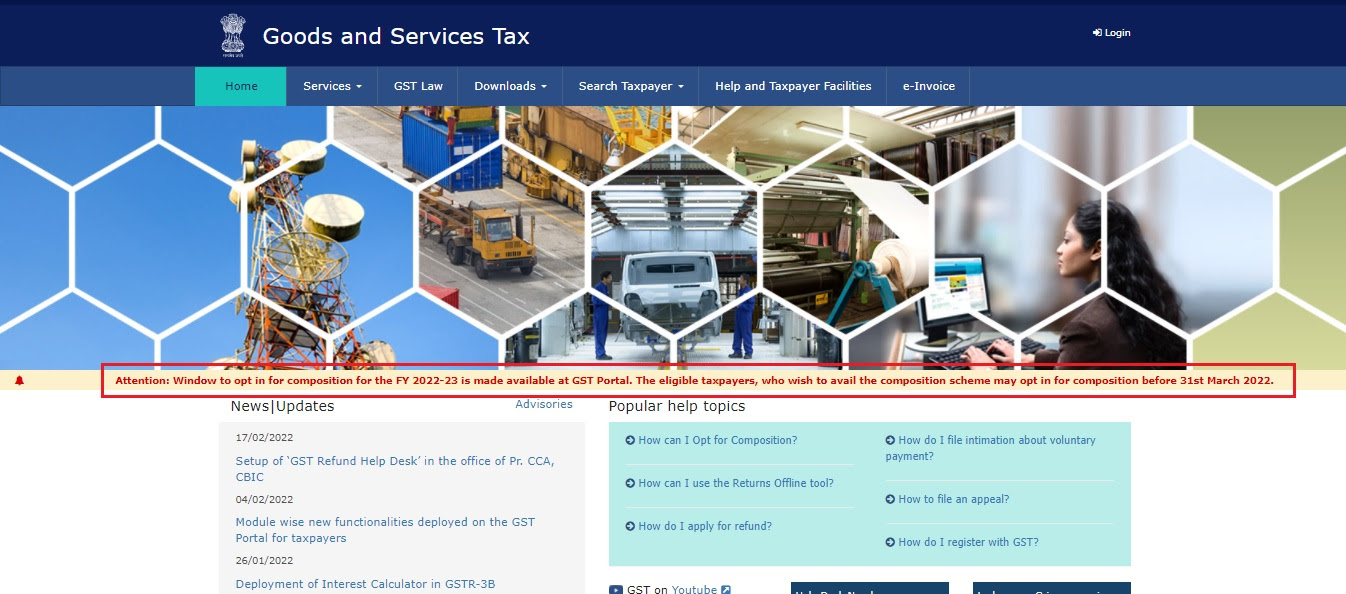
GSTN enabled window to opt in for composition scheme for the FY 2022-23


The Goods and Services Tax Network (“GSTN”) has enabled window to opt in for composition scheme for the FY 2022-23 on GST Portal for the taxpayers.

The eligible taxpayers, who wish to avail the composition scheme may opt in for composition before March 31, 2022.

Source from: https://www.gst.gov.in/


Thursday, 17 February 2022

Coming soon, a structural revamp of GST


The Union government and states will implement a proposed structural revamp of the goods and services tax (GST) in phases, keeping in mind the impact tax rate changes can have on consumption, according to two officials.

The proposed revisions will include pruning tax exemptions, removing anomalies from taxing raw materials and intermediates higher than finished products, and reducing the number of GST slabs, said one of the officials, who spoke on condition of anonymity.

The revisions are currently being studied by two ministerial panels and will entail implementing the tax rate changes needed in the textile industry to correct the inverted duty structure, which have been kept on hold. On 31 December, the council deferred a rate hike from 5% to 12% on several items in the textile and apparel sector, including woven fabrics of cotton, silk and wool, coir mats, apparel and clothing accessories of sale value up to ₹1,000, which was to take effect from 1 January.

An email sent to the finance ministry seeking comments for the story remained unanswered at the time of publishing.

One major shift in the circumstances favouring implementing further structural changes in GST is the expiry of GST compensation to states in June this year, a major concern for states. That would leave a big gap in state budgets, especially of large state economies, which need to find ways of raising revenue receipts. That makes rate and slab rationalization and revenue augmentation methods agreeable to states. Besides, the Centre’s practise of borrowing from the market to meet the shortfall in compensation for FY21 and FY22 have improved Centre-state relations. The GST Council had, in an earlier meeting, decided to collect the GST compensation cess levied on items like automobiles till March 2026, but the proceeds will be used only to repay the loans taken in FY21 and FY22.

“The main concern of states is the expiry of GST compensation in June. Even though the cess collection has been extended, it will only raise adequate resources for paying back the loans already raised. The only way out is to augment revenue from GST, which can be done in one of two ways. It can be done administratively, or you make your rate structure efficient that is, remove exemptions, cut duty inversions and reduce the number of slabs," the official said.

The official said many of the duty inversions have already been corrected, and there is a limit to how much revenue augmentation can be done administratively. “Eventually, you have to fix the rate structure. The group of ministers are likely to come out with a road map. They may not want to do everything in one go. It will be phased. But it has to happen. How they sequence, we do not know yet, but there is this realization that they have to do it now. There is no escape," the official said, adding that concerns about private consumption recovery lagging behind other growth drivers will be factored into while finalizing the proposals.

During post-budget interactions with the industry this month, revenue secretary Tarun Bajaj asked business leaders to share their views with the ministerial panels examining GST rationalization. Karnataka chief minister Basavaraj Bommai leads a panel of state ministers on tax rate rationalization, while Maharashtra deputy chief minister Ajit Pawar heads a panel on GST system reforms. The panels are likely to give their reports this month.

Source from: https://www.livemint.com/economy/revamp-of-gst-likely-in-phases-hike-in-textile-rates-on-cards-11644949326500.html

Thursday, 3 February 2022

Highlights of Union Budget 2022 (केंद्रीय बजट 2022 की मुख्य विशेषताएं)


  • 1.0 DIRECT TAXES 

  • 1.1 Effective Tax Rates 
  • No change in tax rates in respect of income of all categories of assessee.
  •  
  • No change in MAT and AMT rate for companies and other entities except in case of Co-operative Societies where the AMT rate is reduced from 18.5% to 15%.
  •  
  • No change in Surcharge and HEC except the following:
  •  
  • Surcharge on any long term capital gains arising to Individual/ HUF/AOP/BOI under section 112 of the IT Act, restricted to 15%.
  •  
  • Surcharge in case of AOP, consisting of only companies as its members, restricted to 15%.
  •  
  • Surcharge in case of Co-operative society (except resident cooperative society opting for section 115BAD), reduced from 12% to 7% where income exceeds Rs. 1 crore but does not exceed Rs. 10 crore.


  • 1.2 Tax Incentives and Proposals for Business
  •  
  • Section 115BAB of the IT Act is proposed to be amended to extend the date of commencement of manufacturing or production of an article or thing or generation of electricity from 31 March 2023 to 31 March 2024.
  •  
  • It is proposed to further extend the period of incorporation of the eligible start-ups for claiming the tax holiday under section 80-IAC of the IT Act by 1 more year i.e., before 1 April 2023.
  •  
  • It is proposed to amend section 115BBD of the IT Act to provide that the concessional regime for taxation of foreign dividends @15% shall not apply from AY 2023-24 onwards.
  •  
  • It is proposed to include an explanation in the IT Act that for the purposes of section 40(a)(ii) of the IT Act, the term tax includes and shall be deemed to have always included any surcharge or cess, by whatever name called, on such tax. Accordingly, HEC and surcharge shall be disallowed under said section.
  •  
  • It is proposed to insert clarification in section 43B that conversion of interest payable, under section 43B, into debenture or any other instrument by which liability to pay is deferred to a future date, shall not be deemed to be actual payment for the purpose of claiming deduction under the said section.
  •  
  • It is proposed to insert a new explanation 3 to section 37 of IT Act to further clarify that the expression expenditure incurred by an assessee for any purpose which is an offence or which is prohibited by law under explanation 1, shall include and shall be deemed to have always included  the expenditure incurred by an assessee, for any purpose which is an offence under, or which is prohibited by, any law for the time being in force, in India or outside India; or
  •  
  • to provide any benefit or perquisite, in whatever form, to a person, whether or not carrying on a business or exercising a profession, and acceptance of such benefit or perquisite by such person is in violation of any law or rule or regulation or guideline, as the case may be, for the time being in force, governing the conduct of such person; or to compound an offence under any law for the time being in force, in India or outside India.
  •  
  • To clarify that proceedings in case of predecessor entity which ceases to exist pursuant to business reorganization are valid, section 170 proposed to be amended to provide that such proceedings pending or completed on the predecessor shall be deemed to have been made on the successor entity.
  •  
  • In order to enable the successor entity to give effect to business reorganization, it is proposed to insert section 170A allowing the successor entity to file a modified return within 6 months from the end of the month in which the order of competent authority is issued.
  •  
  • It is proposed to insert section 156A to give effect to the orders of the competent authority to modify the income-tax demand as directed by such authority.
  •  
  • It is proposed to insert new section 194R to the IT Act to provide that the person responsible for providing to a resident, any benefit or perquisite, whether convertible into money or not, arising from carrying out of a business or exercising of a profession by such resident, shall before providing such benefit or perquisite, to such resident, deduct the tax @10% of the value or aggregate of value of such benefit or perquisite.


  •   1.3 Personal Taxation
  •  
  • Exemption of following amounts received for medical treatment and on account of death due to COVID-19.
  •  
  • Section 17(2)  Any sum paid by the employer in respect of any expenditure actually incurred by the employee on his medical treatment or treatment of any member of his family in respect of any illness relating to COVID-19 subject to such conditions, shall not be forming part of perquisite.
  •  
  • Section 56(2)(x) (a) Any sum of money received by an individual, from any person, in respect of any expenditure actually incurred by him on his medical treatment or treatment of any member of his family, in respect of any illness related to COVID-19 subject to such conditions, shall not be the income of such person (b) any sum of money received by a member of the family of a deceased person, from the employer of the deceased person (without limit), or from any other person or persons to the extent that such sum or aggregate of such sums does not exceed Rs. 10 lakh, where the cause of death of such person is illness relating to COVID-19 and the payment is, received within 12 months from the date of death of such person, shall not be the income of such person.
  •  
  • It is proposed to allow the deduction under section 80DD of the IT Act during the lifetime, i.e., upon attaining age of 60 years or more of the individual or the member of the HUF in whose name subscription to the scheme has been made and where payment or deposit has been discontinued.
  •  
  • Further, it is proposed that the provisions of sub-section (3) shall not apply to the amount received by the dependent, before his death, by way of annuity or lump sum by application of the condition referred to in the proposed amendment.
  •  

  • 1.4 Non-residents
  •  
  • The income of a non-resident from offshore derivative instruments, or over the counter derivatives issued by an offshore banking unit, income from royalty and interest on account of lease of ship and income received from portfolio management services in IFSC shall be exempt from tax, subject to specified conditions.
  •  
  • 1.5 Other Proposals
  •  
  • It is proposed to introduce section 139(8A) of the IT Act wherein any person, whether or not he has furnished a return, may furnish an updated return of his income or the income of any other person in respect of which he is assessable under the IT Act, within 24 months from the end of the assessment year, subject to other prescribed conditions, in prescribed form and manner containing such particulars.
  •  
  • It is proposed to introduce section 115BBH which provides that any income from transfer of any virtual digital asset shall be taxed @ 30% and no deduction would be allowed for any expenditure or set-off of losses. Further, loss from transfer of such assets shall not be allowed.                        It is also proposed to amend Explanation to section 56(2)(x) of the IT Act to interalia, provide that for the purpose of the said clause, the expression property shall include virtual digital asset.
  •  
  • In order to capture the transaction details, it is proposed to introduce section 194S under the IT Act which provides for TDS on payment made to a resident in relation to transfer of virtual digital assets @1% of such sum above a monetary threshold and certain other conditions.
  •  
  • Certain provisions applicable to trusts and institutions covered under section 11 and section 12 (referred as second regime) to be made  applicable to trusts and institutions covered under section 10(23C) (referred as first regime). Further, various clarifications on taxation in respect of these charitable trusts and institutions proposed.
  •  
  • It is proposed to amend the provisions of section 68 to provide that the nature and source of any sum, whether in form of loan or borrowing, or any other liability credited in the books of an assessee shall be treated as explained only if the source of funds is also explained in the hands of the creditor or entry provider.
  •  
  • Section 148 proposed to be amended to clarify what constitutes information under Explanation 1 to section 148 and it proposes to include any audit objection, or any information received from a foreign jurisdiction under an agreement or directions contained in a court order, or information received under a scheme notified under section 135A, etc. Further, section 149 proposed to be amended to provide that a notice under section 148 shall be issued up to 10 years from end of the relevant assessment year where the Assessing Officer has in his possession books of account or other documents or evidence which reveal that the income chargeable to tax, represented (a) in the form of an asset or (b) expenditure in respect of a transaction or in relation to an event or occasion or (c) an entry or entries in the books of accounts.
  •  
  • The requirement of higher TDS / TCS shall be applicable in case of nonfiling of tax return by the payee for preceding 1 year instead of 2 years as earlier provided. Further, deduction of tax under section 194 IA, 194 IB and 194M excluded from the operation of section 206AB of the Act.
  •  
  • Provisions of section 94(8) of the IT Act relating to bonus stripping proposed to be amended to include securities as well. Further, definition of units proposed to be amended to include units of business trusts for dividend and bonus stripping.
  •  
  • It is proposed to amend section 194-IA of the IT Act and to provide that in case of transfer of an immovable property (other than agricultural land), TDS to be deducted @ 1% of such sum paid or credited to the resident transferor or the stamp duty value of such property, whichever is higher.
  •  
  • It is proposed to insert section 79A of IT Act to provide that, notwithstanding anything contained in the Act, no set-off of brought forward loss or unabsorbed depreciation shall be allowed against any undisclosed income unearthed during the course of search and survey proceedings.
  •  
  • It is proposed that the existing provisions are replaced with section 144B to streamline the process of faceless assessment in order to address various legal and procedural problems being faced in implementation of the said section. Section 144B(9) treating the proceedings to be void on non compliance of procedure laid down under the said section, proposed  to be omitted from date of its inception.
  •  
  • It is proposed that the revision of transfer pricing assessment order under section 263 shall be within the powers of the PCCIT or CCIT or PCIT or CIT who is assigned the jurisdiction of transfer pricing.
  •  
  • Procedure prescribed under section 158AB for deferral of revenue appeal where identical question of law is pending before jurisdictional High Court or Supreme Court in case of any other assessment year of the assessee or in case of any other assessee.
  •  

  • 2.0 INDIRECT TAXES

  •  
  • 2.1 GST, Custom & Excise
  •  
  • 2.1.1 CGST Act Amendments
  •  
  • Time limit for claiming input tax credit (ITC) under section 16(4) extended to 30th November of the succeeding financial year as against the due date of September's Form GSTR 3B               Time limit for issuing credit note under section 34(2), rectification of errors in GSTR 1 and GSTR 3B and section 52 (6) extended to 30th November of succeeding financial year as against September earlier
  •  
  • Insertion of new clause Section 16(2) (ba) restricting availment of ITC as communicated to the taxpayer under section 38.
  •  
  • Cancellation of registration of composition dealer if the returns not furnished for a FY beyond 3 months from the due date Cancellation of registration in cases other than composition dealer in case if returns are not furnished for continuous tax period as may be prescribed.
  •  
  • The due date for filing GSTR 5 by Non 􀁅resident taxable person has been stated as 13th day of the following month
  •  
  • Section 38 of the CGST Act is substituted for prescribing the manner, conditions and restrictions for communication of details of inward supplies and input tax credit.
  •  
  • Section 41 of the CGST Act is being substituted to do away with the concept of "claim" of ITC on"provisional" basis Removal of section 42, 43 and 43A of the CGST Act.
  •  
  • In order to do away with two-way communication process in return filing system Section 47 of the CGST Act is being amended so as to provide levy of late fees for delayed filing of TCS returns Section 49 is being amended to provide restriction for the amount available in electronic credit Ledger (ECL) and the maximum proportion of output tax liability which may be discharged through the ECL
  •  
  •  Section 49 also allows transfer of amount available in electronic cash ledger of registered person to the electronic cash ledger of distinct person.
  •  
  • Section 54 of the CGST act is being amended to provide for the situation of refund of balance in electronic cash ledger. Insertion of sub clause (ba) in clause (2) in section 54 by providing clarity regarding the relevant date for filing refund claim in relation to supplies made to SEZ/ SEZ (developer).
  •  
  • The relevant date for claiming refund of tax paid on inward supply under section 55 has been clarified as two years from the last day of the quarter in which the said supply is received.
  •  
  •  
  • Inclusion of officer of Directorate of Revenue Intelligence, Audit and Preventive formation in the class of officers for the purpose of section 3 (i.e. definition of officer)
  •  
  • Section 14 is being amended to include provisions for rules enabling the Board to specify the additional obligations of the importer in respect of a class of imported goods whose value is not being declared correctly, the criteria of selection of such goods, and the checks in respect of such goods.
  •  
  • Applicant can withdraw his application in respect of advance ruling at any time before pronouncement of advance ruling. Also, Advance ruling shall remain valid for three years or till there is change in law or facts, whichever is earlier.
  •  
  • Publishing of import and export data submitted by importer to Customs is declared an offence unless required under law.
  •  
  • Procedural changes are made in Customs (Import of goods at concessional rate of duty) Rules, 2017.
  •  
  • 2.1.3 Changes in Customs Duty Rate and Exemption
  •  
  • BCD rate on imitation jewellery has been amended to 20% or Rs 400/kg whichever is higher.
  •  
  • Decrease in BCD on cut and polished diamond and cut and polished natural stones from 7.5% to 5%
  •  
  • Increase in BCD on electrical and electronic items Increase in BCD rate on Solar Cells (other than those exclusively used with ITA-1 items) and Solar Modules (other than those exclusively used with ITA-1 items)
  •  
  • Decrease in BCD rate for textile products
  •  
  • Decrease in BCD rate for ferrous waste and scrap
  •  
  • Effective BCD rate on Project Imports would continue to be 􀀼Nil / 2.5% / 5% (as applicable) till 30 September 2023 for the project imports registered till 30 September 2022.
  •  
  • For other project imports, 7.5% BCD rate will be applicable from 01 October 2022.
  •  
  • All project imports will attract 7.5% BCD rate after 30 September 2023
  •  
  • Certain Cesses (AIDC, Health Cess and RIC) are being exempted for specified notifications
  •  
  • Nil BCD on scrap of iron and steel is being extended up to 31 March 2023
  •  
  • The Customs duty rate structure on capital goods and project imports has been comprehensively reviewed and exemption on capital goods/ project imports are being phased out in a gradual manner.
  •  
  • However, certain exemptions on capital goods would continue
  •  
  • A new entry at S. No. 166A would be inserted w.e.f. 1 April 2024 providing a concessional rate of 5% for bulk drugs falling under Chapters 28, 29 or 30 used in the manufacture of Poliomyelitis Vaccine or Monocomponent insulins subject to importer following IGCR Rules 2017
  •  
  • There have been proposals involving changes in effective basic custom duty rates in respect of phased manufacturing program (PMP) with respect to specific electronic goods.
  •  
  • 2.1.4 Changes in Anti-Dumping Duty (ADD)
  •  
  • ADD is permanently revoked on import of :
  •  
  • 1) Straight length bars, rods of alloy steel from China.
  •  
  • 2) High Speed Steel of Non-Cobalt Grade from Brazil, China and Germany 3) Flat rolled product of steel, plated or coated with alloy of Aluminium or Zinc from China, Vietnam and Korea RP
  •  
  • 2.1.5 Changes in Countervailing Duty (CVD)
  •  
  • CVD is permanently revoked on imports of Certain Hot Rolled and Cold Rolled Stainless Steel Flat Products from China.
  •  
  • 2.1.6 Changes in Excise Duty
  •  
  • Two new tariff items, namely, 2710 12 43 and 2710 12 44, falling under Chapter 27, have been inserted in the Fourth Schedule to the Central Excise Act, 1944 with rate of duty as 14% plus Rs 15 per litre.
  •  
  • 2.1.7 Changes in National Calamity Contingent Duty (NCCD)
  •  
  • The Seventh Schedule of the Finance Act, 2001, is being amended by substituting Central Excise tariff item 2709 20 00 with 2709 00 10 [Petroleum Crude] with rate of duty as Rs 50 per tonne.